
How much does a YouTube Shorts creator make per 1 million views?
A YouTube Shorts creator makes roughly $20 to $100 in ad revenue per 1 million views, with most channels landing near $40 to $60. That is the platform payout only — before tax, and before sponsorships, affiliate income or other revenue. A US- or UK-heavy audience pays more: a 274-channel study puts the median at about $328 per 1 million views for a US audience and about $166 for a UK audience. Either way, the answer is tens or low hundreds of dollars, not thousands.
The surprise is the gap. The same million views on a long-form video typically earns $2,000 to $12,000 in ad revenue — roughly 20 to 50 times more. Shorts pay so little because they are paid from a shared pool, not from ads sold against the individual video, and because the creator keeps 45% of their allocated share rather than the 55% long-form creators keep.
Table of Contents
How much does a YouTube Shorts creator make per 1 million views: the verified ranges
There is no official YouTube rate for Shorts. YouTube publishes the revenue-share rules but no RPM table, so every per-million figure is a creator-reported range or a study of creator data.
| Source | Shorts RPM (per 1,000 views) | Pay per 1 million views | Date |
|---|---|---|---|
| Creators surveyed by Business Insider | $0.04–$0.06 | $40–$60 | Feb 2023 |
| AIR Media-Tech / MilX study, 274 channels | $0.07–$0.20 (most niches) | $70–$200 | 2026 |
| AIR Media-Tech / MilX, US audience median | $0.328 | ~$328 | 2026 |
| AIR Media-Tech / MilX, UK audience median | $0.166 | ~$166 | 2026 |
| Digiday, six long-form creators | Under $0.20 | Under $200 | Feb 2025 |
| vidIQ’s own channel | ~$0.09 | ~$95 | Reported 2026 |
| Creator case reported to Business Insider | ~$0.05 | ~$55 (from $383 on ~7m views) | 2023 |
| Typical creator-reported band, all sources | $0.01–$0.10 | $20–$100 | 2023–2026 |
The honest planning range for most creators is therefore $20 to $100 per 1 million Shorts views, with $40 to $70 as the middle of the band. Channels with mostly US or UK viewers in higher-paying niches can reach $150 to $330 per million; channels with audiences in lower-paying countries, or in kids’ and entertainment niches, can fall below $20.
One genuine outlier exists: small music channels in the AIR Media-Tech study recorded Shorts RPMs of $0.97 to $1.48, or roughly $970 to $1,480 per million views — but that reflects rights holders earning through Content ID as well as creators, and it does not apply to ordinary Shorts.
Note what the ranges measure. Shorts RPM is revenue per 1,000 engaged views — views YouTube counts for payment — not the public view counter. Since 31 March 2025, the public counter on a Short counts every play and replay, while payment is based on engaged views, so a Short showing 1 million public views may have far fewer engaged views.
How Shorts pay actually works: the Creator Pool and the 45% share
Shorts do not work like long-form video. On a long video, ads play on that video and the creator keeps 55% of the net ad revenue. On Shorts, ads play between Shorts in the feed, so no single creator’s video carries the ad.
YouTube’s own Help pages describe a four-step system: each month YouTube pools all the revenue from ads shown between Shorts, country by country; it calculates the Creator Pool, splitting revenue tied to Shorts that use licensed music with music partners (one track sends half to music licensing, two tracks send two-thirds); it allocates the pool to monetising creators by their share of total eligible engaged views in each country; and creators keep 45% of their allocated revenue, whether or not they used music.
YouTube’s own Help page gives a hypothetical example: in a country with 100 million engaged views and £100,000 of Shorts Feed ad revenue, music licensing takes £10,000, leaving a £90,000 Creator Pool. A Short with 1 million engaged views is allocated 1% of the pool, or £900, and after the 45% share the creator earns £405. That illustrates the arithmetic, not a benchmark — real pools are far thinner per view, which is why real creator reports land at $40 to $60 rather than $405. It also shows a creator’s allocation is not reduced by using music, because the music cost comes out of the shared pool before the split.
YouTube Premium revenue works the same way (45% for Shorts, 55% for long-form), and Shorts only pay for Partner Program creators who have accepted the separate Shorts Monetisation Module — views earned before accepting it are never paid retroactively.
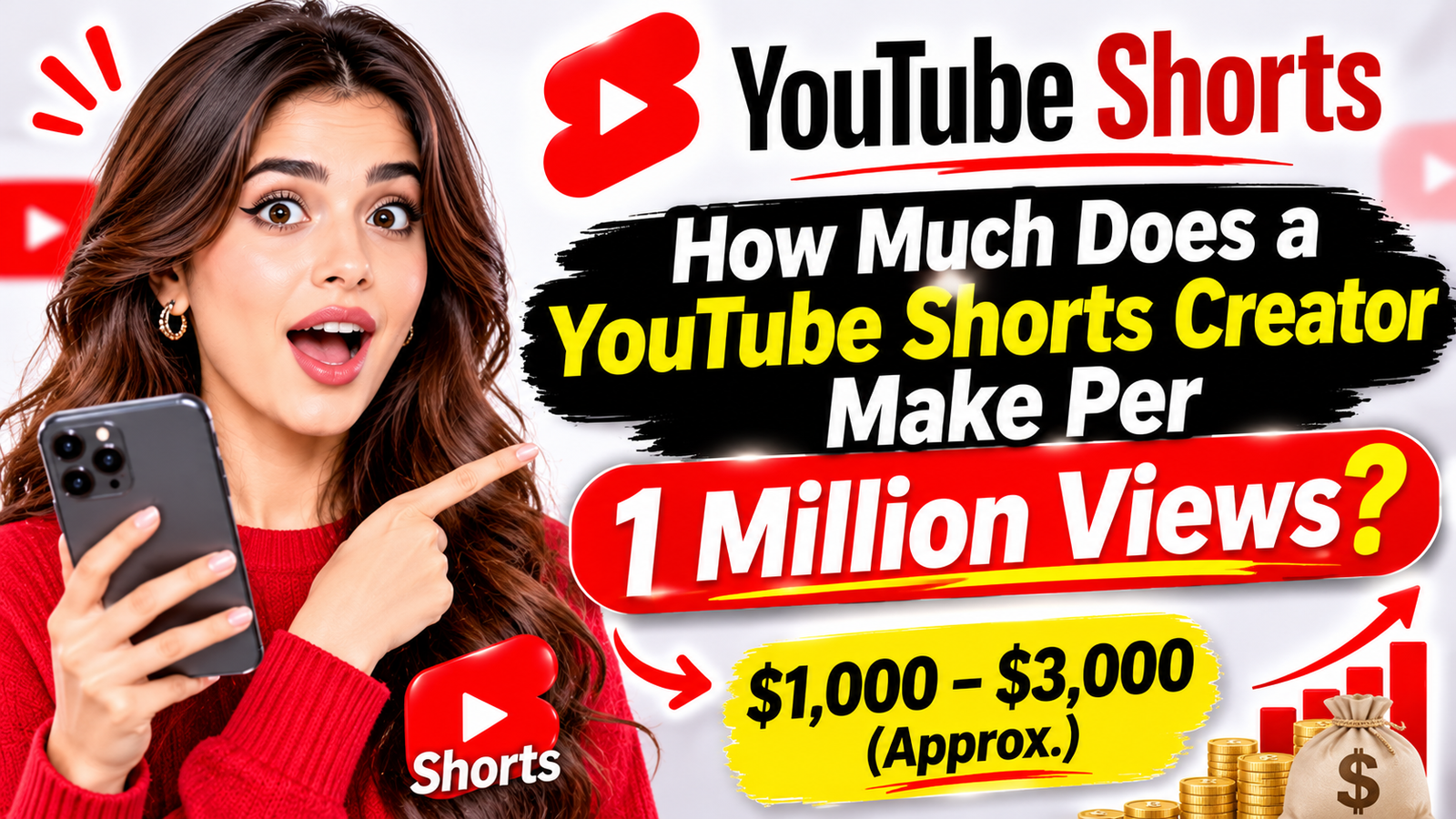
The $1,000–$3,000 figure on the thumbnail
The thumbnail made for this topic prints “$1,000–$3,000 approx. per 1M views”. That figure could not be verified for Shorts from any source checked on 10 November 2026, and it should not be used. Every verified Shorts source puts the figure at least ten times lower.
Where does $1,000 to $3,000 come from? It is a plausible figure for the wrong format. It matches long-form earnings: vidIQ published its own channel’s long-form analytics showing $3,231 from about 1,035,000 views, and WorthQuiva’s own UK guide puts entertainment long-form content at £1,000 to £3,000 per million views. In other words, the thumbnail figure looks like a long-form pay rate attached to Shorts — the single most common error in this topic. A creator quoting $1,000 to $3,000 per million Shorts views is almost certainly quoting long-form RPM, a CPM (what advertisers pay) rather than RPM (what the creator keeps), or a figure that folds in sponsorships and brand deals. None of those is the Shorts ad payout.
Shorts vs long-form: the same million views, 20 to 50 times apart
The comparison is the reason this question gets searched, and the numbers are stark. Digiday reported in February 2025 that six creators who mainly make long-form videos all had Shorts RPMs consistently under $0.20, against average long-form RPMs of $3 to $6. Two creators gave both numbers: Maldhound reported about $0.18 on Shorts against about $5.50 on 20- to 30-minute videos, and LordDraconical reported about $0.20 on Shorts against about $3.33 on long-form. On the same channel, a long-form view earned roughly 17 to 31 times what a Shorts view did.
| Measure | YouTube Shorts | Long-form video |
|---|---|---|
| Typical RPM (per 1,000 views) | $0.01–$0.20 | $2–$12 |
| Pay per 1 million views | Roughly $20–$100 (most creators) | Roughly $2,000–$12,000 |
| Creator share of ad revenue | 45% of allocated Creator Pool share | 55% of net watch-page ad revenue |
| How ads are sold | Pooled ads between Shorts in the feed | Ads on the video itself, including mid-rolls |
Three mechanics create the gap: the pool spreads Shorts ad money across every eligible view in a country; the share is 45% instead of 55%; and a 20-minute video can carry several mid-roll ads while a 40-second Short carries none of its own. Shorts are best understood as a discovery engine feeding viewers to higher-paying long-form videos, not as an income line on their own.
What moves a Shorts creator’s rate up or down
Audience country matters most. In the AIR Media-Tech and MilX study, median Shorts RPM by audience country was $0.328 in the United States, $0.193 in Australia, $0.166 in the United Kingdom, $0.165 in Canada and $0.163 in Germany. A US audience is worth roughly twice a UK one per million views, and several times an audience in a low-CPM country.
Niche matters second. Finance, business and education Shorts sit at the top of the range, because advertisers pay more to reach those audiences; entertainment, gaming and kids’ content sit at the bottom — the same pattern as long-form, compressed into a much lower band.
Music changes the pool, not your share. A licensed track does not cut an individual creator’s allocation, but its cost leaves the shared pool before the split. Season matters too: demand peaks in the final quarter and troughs in the first — a million Shorts views in December pays more than the same million in January.
How much does a YouTube Shorts creator make per 1 million views in pounds?
UK creators are paid through AdSense in pounds, and the verified figures are published in dollars, so the pound figure is a conversion, not a separate rate. The typical $20 to $100 band per million views works out to roughly £15 to £75 at typical 2026 exchange rates, and the UK-audience median of about $166 per million engaged views works out to roughly £120. The research note behind this article suggested £20 to £100 per million views, which sits inside the verified band — the low-to-middle of the range, not a separate finding. Treat any pound figure as approximate: AdSense converts at the rate on the payment date.
Timeline: from the Shorts Fund to the 2027 rule change
May 2021: YouTube launches the Shorts Fund, a $100 million pool of monthly bonuses ($100–$10,000) for top Shorts creators. Shorts earn no ad revenue yet.
1 February 2023: Shorts ad revenue sharing begins. The Shorts Fund ends, replaced by the Creator Pool model with the 45% creator share. Business Insider’s first-weeks survey finds Shorts RPMs of $0.04–$0.06 (Ammon Runger $0.05, James Seo $0.05, Kaz Sawyer $0.04).
February 2025: Digiday reports that two years into revenue sharing, Shorts payouts are still dwarfed by long-form, with the six creators it spoke to all under $0.20 Shorts RPM against $3 to $6 long-form.
31 March 2025: the public Shorts view counter changes to count every play and replay, while payment stays based on engaged views — widening the gap between the number on screen and the number that pays.
10 August 2026: YouTube announces that from 1 February 2027, creators will need at least 10 million qualified Shorts views in the last 90 days to earn Shorts ad and Premium revenue in a given month. New applicants through the Shorts route will need 20 million qualified Shorts views in 90 days, or 8,000 qualified watch hours in 365 days. The 45% share itself does not change.
10 November 2026: Reporting date for this article. The verified ranges above are the latest available.
The February 2027 change matters for small and mid-size channels: a channel earning 1 to 2 million Shorts views a month will stop earning from the pool entirely, while its long-form earnings are unaffected.
What 1 million Shorts views does not mean
First, it is not a salary. At $40 to $60 per million views, a creator would need roughly 17 to 25 million Shorts views a month to reach $1,000 a month from Shorts ads alone — and from February 2027 they need 10 million views in 90 days just to stay eligible. Very few channels sustain that volume.
Second, ad revenue is not total earnings. Shorts creators who make a living from the format earn most of their money outside the Creator Pool: brand sponsorships, affiliate links, channel memberships, merchandise, Super Thanks and driving viewers to long-form videos. TikTok’s Creator Rewards pays a reported $0.40–$1.00 per 1,000 qualified views — roughly $400–$1,000 per million — yet TikTok creators still report sponsored posts as their main income. The same logic applies on YouTube: a million Shorts views is worth far more as an audience to sell to a sponsor than as an ad payout.
Third, a platform payout is not personal wealth. One million views paying $50 says nothing about what a creator owns, owes or is worth: ad revenue is gross income before tax and costs, and it only becomes wealth after those are paid.
The bottom line
How much does a YouTube Shorts creator make per 1 million views? Roughly $20 to $100 in ad revenue, most often $40 to $60, with US- and UK-heavy audiences reaching roughly $166 to $328 per million engaged views. The figure that circulates most confidently — $1,000 to $3,000 — is a long-form number, not a Shorts number, and it is roughly 20 to 50 times too high. A million Shorts views is a genuine achievement and a real audience. As a pay cheque on its own, it buys lunch, not a living.
Frequently asked questions
How much does a YouTube Shorts creator make per 1 million views?
Roughly $20 to $100 in ad revenue, most often $40 to $60, based on creator-reported Shorts RPMs of $0.04 to $0.06 (Business Insider, 2023) and the AIR Media-Tech / MilX study of 274 channels (2026). US and UK audiences pay more — about $328 and $166 per million engaged views at the median. The figure is ad revenue only, before tax.
Is the $1,000–$3,000 per 1 million Shorts views figure real?
No — not for Shorts ad revenue. No source checked for this article supports it. It matches long-form earnings instead: vidIQ’s own channel earned $3,231 from about 1,035,000 long-form views, and entertainment long-form content in the UK is reported at £1,000 to £3,000 per million views. The figure appears to be a long-form rate attached to Shorts, or a CPM confused with RPM.
How much does a YouTube Shorts creator make per 1,000 views?
A few cents: typically $0.01 to $0.20 per 1,000 views depending on niche and audience country. Business Insider’s 2023 survey of creators found $0.04 to $0.06; the AIR Media-Tech / MilX study found a $0.07 to $0.20 median in most niches, $0.328 for a US audience and $0.166 for a UK audience. Your own figure is in YouTube Studio under Analytics, then Revenue.
Why do Shorts pay so much less than long-form videos?
Shorts revenue comes from a shared Creator Pool split by engaged views, not from ads on the creator’s own video; creators keep 45% of their allocation instead of 55%; and Shorts carry no mid-roll ads. Digiday’s February 2025 reporting put the gap at roughly 17 to 31 times on the same channels.
How many Shorts views do you need to make $1,000 a month?
At a $0.05 RPM, about 20 million Shorts views a month; at a $0.10 RPM, about 10 million; at the UK-audience median of $0.166, about 6 million. And from 1 February 2027, a channel needs at least 10 million qualified Shorts views in the last 90 days to earn from the Creator Pool at all. Most creators who earn a living from Shorts do so through sponsorships and other income, not ad revenue alone.
Can you make money from Shorts without joining the Partner Program?
No. Only monetising partners who have accepted the Shorts Monetisation Module earn ad and Premium revenue from Shorts; the $100 million Shorts Fund ended on 1 February 2023. Fan funding such as Super Thanks is available from 500 subscribers, but those are viewer tips, not pay per view.
Evidence register
| Claim | Source and URL | Publication date | Valuation / event date | Evidence type | Limitation | Confidence |
|---|---|---|---|---|---|---|
| Creators keep 45% of allocated Shorts revenue; Creator Pool mechanics; music split (1 track half, 2 tracks third) | YouTube Help, Shorts monetisation policies — https://support.google.com/youtube/answer/12504220?hl=en-GB | Accessed 10 Nov 2026 | Current policy | Verified disclosed fact (official) | Policy page, not a payout rate | High |
| YouTube hypothetical example: 1m engaged views → £900 allocation → £405 after 45% share | YouTube Help, Shorts monetisation policies — https://support.google.com/youtube/answer/12504220?hl=en-GB | Accessed 10 Nov 2026 | Hypothetical example | Verified disclosed fact (official illustration) | Illustration of arithmetic, not a benchmark; real pools pay far less per view | High (as illustration) |
| Shorts RPM $0.04–$0.06 per 1,000 views; $40–$60 per 1m views | Business Insider creator survey (Feb 2023), via QuickVeed — https://quickveed.com/blogs/how-much-do-youtube-shorts-pay | Survey Feb 2023; relay accessed 10 Nov 2026 | Feb 2023 | Attributed third-party estimate (creator self-reports) | Small survey from launch weeks; relayed second-hand; rates may have moved since | Moderate |
| Individual RPMs: Ammon Runger $0.05, James Seo $0.05, Kaz Sawyer $0.04 | Business Insider (16 Feb 2023), via MarkStudios — https://www.markstudios.com/research/youtube-cpm-rpm | 16 Feb 2023; relay accessed 10 Nov 2026 | Feb 2023 | Attributed third-party estimate (creator self-reports) | Three creators only; relayed second-hand | Moderate |
| Median Shorts RPM $0.07–$0.20 most niches; US $0.328, UK $0.166, Australia $0.193, Canada $0.165, Germany $0.163; music $0.97–$1.48 | MilX / AIR Media-Tech, 274 channels, 3,044 channel-months — https://milx.app/en/guidelines/youtube-shorts-monetization-guide | Guide accessed 10 Nov 2026 | 2026 (12-month medians) | Attributed third-party estimate (study of creator analytics) | Study by a creator-monetisation platform; medians, not a rate card | Moderate |
| Six creators: Shorts RPM consistently under $0.20 vs long-form $3–$6; Maldhound $0.18 vs $5.50; LordDraconical ~$0.20 vs ~$3.33 | Digiday — https://digiday.com/media/how-youtube-shorts-revenue-compares-to-long-form-video-revenue-for-creators/ | 25 Feb 2025 | Feb 2025 | Attributed third-party estimate (creator self-reports) | Six creators, all long-form-first; self-reported | Moderate |
| vidIQ earned ~$95 for ~1m Shorts views (~$0.09 RPM); long-form $3,231 from ~1,035,000 views | vidIQ published analytics, via TubeMind — https://tubemind.io/blog/how-much-does-youtube-pay-for-1-million-views | Relay accessed 10 Nov 2026 | 2026 | Attributed third-party estimate (single channel’s published analytics) | One channel; relayed second-hand | Moderate |
| Creator earned ~$383 from ~7m Shorts views (~$0.05 per 1,000) | Business Insider-cited creator, via TubeMind — https://tubemind.io/blog/how-much-does-youtube-pay-for-shorts | Relay accessed 10 Nov 2026 | 2023 | Attributed third-party estimate (creator self-report) | Single case; relayed second-hand | Low |
| Shorts Fund $100m launched May 2021, ended 1 Feb 2023, replaced by ad revenue sharing | Engadget — https://www.engadget.com/youtube-will-begin-sharing-ad-revenue-with-shorts-creators-on-february-1st-190718650.html | 9 Jan 2023 | May 2021–Feb 2023 | Verified disclosed fact (reported announcement) | — | High |
| From 1 Feb 2027: 10m qualified Shorts views in 90 days needed monthly to earn from the pool; new applicants 20m views or 8,000 hours; announced 10 Aug 2026 | YouTube Help — https://support.google.com/youtube/answer/12504220?hl=en-GB ; MilX — https://milx.app/en/guidelines/youtube-shorts-monetization-guide | Accessed 10 Nov 2026 | Announced 10 Aug 2026; effective 1 Feb 2027 | Verified disclosed fact (official) | Future rule; details may change before it takes effect | High |
| Public Shorts counter counts every play/replay since 31 Mar 2025; payment on engaged views | MilX — https://milx.app/en/guidelines/youtube-shorts-monetization-guide | Guide accessed 10 Nov 2026 | 31 Mar 2025 | Attributed report (of YouTube change) | Threshold for “engaged” is not published by YouTube | Moderate |
| Long-form RPM roughly $2–$12 per 1,000 views; Shorts $0.01–$0.30 | WorthQuiva, How Much Does YouTube Pay Per 1,000 Views — https://worthquiva.com/how-much-does-youtube-pay-per-1000-views/ | Published 3 Nov 2026 | 2025–2026 benchmarks | Attributed third-party estimate (benchmarks) | Third-party benchmarks, not official YouTube rates | Moderate |
| UK entertainment long-form £1,000–£3,000 per 1m views; UK long-form £1,500–£6,000 typical | WorthQuiva, How Much Does YouTube Pay for 1 Million Views in the UK — https://worthquiva.com/how-much-does-youtube-pay-for-1-million-views-in-the-uk/ | Published 4 Nov 2026 | 2025–2026 benchmarks | Attributed third-party estimate (benchmarks) | Long-form only; cited here to explain the thumbnail figure’s likely origin | Moderate |
| Thumbnail figure “$1,000–$3,000 approx. per 1M views” for Shorts | Thumbnail supplied for this topic (image-92.png series) | Received 10 Nov 2026 | — | Unverified claim | No source found supporting it for Shorts; contradicted by every verified Shorts source; matches long-form rates | Unverified |
| TikTok Creator Rewards $0.40–$1.00 per 1,000 qualified views (~$400–$1,000 per 1m) | WorthQuiva, How Much Do TikTokers Make Per Sponsored Post — https://worthquiva.com/how-much-do-tiktokers-make-per-sponsored-post/ | Published 3 Nov 2026 | 2025–2026 | Attributed third-party estimate | Third-party benchmarks; TikTok rates vary by market | Moderate |
Sources
- YouTube Help, “YouTube Shorts monetisation policies” — https://support.google.com/youtube/answer/12504220?hl=en-GB
- MilX / AIR Media-Tech, “Shorts monetization guide 2026” (274 channels, 3,044 channel-months) — https://milx.app/en/guidelines/youtube-shorts-monetization-guide
- Digiday, “How YouTube Shorts revenue compares to long-form revenue,” 25 February 2025 — https://digiday.com/media/how-youtube-shorts-revenue-compares-to-long-form-video-revenue-for-creators/
- Engadget, “YouTube will begin sharing ad revenue with Shorts creators on February 1st,” 9 January 2023 — https://www.engadget.com/youtube-will-begin-sharing-ad-revenue-with-shorts-creators-on-february-1st-190718650.html
- AIR Media-Tech, “What is YouTube Shorts monetization? Shorts Fund vs Ad Revenue Share” — https://air.io/en/youtube-glossary/what-is-youtube-shorts-monetization-shorts-fund-vs-ad-revenue-share
- QuickVeed, “How Much Do YouTube Shorts Pay? Per 1,000 and 1M Views” (Business Insider 2023 survey) — https://quickveed.com/blogs/how-much-do-youtube-shorts-pay
- MarkStudios, “YouTube CPM and RPM by Niche” (Business Insider 16 Feb 2023 creator figures) — https://www.markstudios.com/research/youtube-cpm-rpm
- TubeMind, “How Much Does YouTube Pay for 1 Million Views? (2026)” (vidIQ published analytics) — https://tubemind.io/blog/how-much-does-youtube-pay-for-1-million-views
- TubeMind, “How Much Does YouTube Pay for Shorts? (Real 2026 Data)” — https://tubemind.io/blog/how-much-does-youtube-pay-for-shorts
- WorthQuiva, “How Much Does YouTube Pay Per 1,000 Views? RPM by Niche” — https://worthquiva.com/how-much-does-youtube-pay-per-1000-views/
- WorthQuiva, “How Much Does YouTube Pay for 1 Million Views in the UK?” — https://worthquiva.com/how-much-does-youtube-pay-for-1-million-views-in-the-uk/
- WorthQuiva, “How Much Do TikTokers Make Per Sponsored Post? Rates by Follower Count” — https://worthquiva.com/how-much-do-tiktokers-make-per-sponsored-post/